Showing posts with label Energy. Show all posts

Sunday, November 15, 2015

Outsourcing for electricity

Kyle and I are both having to learn a lot of new things to pursue this project. We quite enjoy that part, but there comes a point where we simply don't have time to learn everything we need to. One of the most significant areas was electrical wiring and solar panels. This is a big, sometimes complicated area that we knew very little about to start with (by very little I mean high school science level of understanding, enough to figure out where the cables need to go but not which parts to buy). The learning curve is not insurmountable, but the time it would take would mean there are other things we can't learn that we need to. Just like money, and building materials, and space, time is a resource we have to budget for.

So we're outsourcing for the electrical wiring. Not necessarily to a professional electrician (though we know we legally have to have one to do any 240V wiring), but to my Dad who has kindly offered to help. Dad had to learn all about solar panels and wiring when he built a motorhome a few years ago, which he and my Mum drove from Malaysia to Scotland and back (for real - go check it out). So he has a fair bit of experience with solar systems (though a bit smaller than the system we'll have), and how to repair them when something goes bung and you can't just drop down to the store for parts.

At some point we'll get Dad to do a guest post about it all, because we don't know very much about it yet (we're getting Dad to do it so we don't have to spend time learning just yet).

Saturday, February 28, 2015

Barrel Ovens

I've done a fair amount of cooking on campfires in the past, when Kyle and I were very involved with the local historical re-enactment society, with smoke stinging my eyes and my hair all in the way. It's always a bit of a bother, and nothing ever seems clean. Given that we'll likely be camping for the month or two of building the little 'prototype' house, and will be inviting a lot of people to help, I wasn't particularly looking forward to the prospect of cooking for 20-30 people for any length of time. I've done it before, but it's not fun.


So I started looking for alternatives, as you do. Wood fired ovens came up over and over again, partly as they seem one of the few things that enjoy popularity with both off-grid eco-enthusiasts such as ourselves and the more 'regular' love-to-watch-Better-Homes-and-Gardens type people. Everyone seems to want one. But, again, they seemed like a fair amount of bother.

Then I found barrel ovens. No 3-4 hours of stoking the fire in advance, but similar efficiency. Seems like a no-brainer.


Kits for the metalwork can be ordered in the US through a company delightfully called Firespeaking, but even if they would ship to Australia I suspect the postage would be prohibitive, so we will need to make this ourselves. At this stage Kyle pointedly reminds me that I had said he could one day buy a welder, and perhaps that day has come. Seems like this will work out well.


In my head at least it makes good sense to begin the metal work for the barrel oven anytime from now, then begin building the brickwork as soon as we purchase land as we don't need permits for this type of thing. Old fired bricks are dirt cheap at the local tip-shop - we go every weekend and they always have stacks of them around. By the time we get around to having permits for the house and having all those people around the oven will have dried, been test-fired, and be ready to go!

Saturday, December 6, 2014

Preparation

There are many aspects of a project like this for which Kyle and I are not really sure what to expect. Personally I think that's part of the fun of it - who wants to live a quiet, comfortable life anyway? However that does tend to lend itself to a bit of risk. We don't want to get to the point where we're lying awake at night ravaged by thoughts of "what if?" (well, not too much).

What if it turns out we're no good at earthbag building after all?
What if we can't find all the pre-loved materials we need for the build?
What if the banks won't give us a mortgage on land for a project like this?

Most of these big "what if's" we can deal with in advance by doing our homework and being careful about what we commit our resources to before we move to the next step. But sometimes doing your homework on what others have done before us isn't enough. Sometimes, we just have to get obsessive about the details.

What if we can't actually survive on solar panels?

Quite some time ago I had assumed we'd need to build our own fridge eventually as part of this project, so we weren't particularly concerned about having to ditch a few appliances. It does seem necessary, though, to be able to quantify our electrical needs to work out whether we need to replace core appliances with models that place less load on the system.

Enter our new electrical usage monitor:


Obviously I've got our electrical bill for the past however-many years we've lived here, with its helpful little graphs comparing our 2-person household with others in the area, but the value of this information is extremely limited as it includes things like heaters and fans, the use of which will be very limited in the new house, and the inefficient light fittings that our landlord refused to let us replace. So, over the next few weeks I'm going to track our electrical usage in as much detail as I can so that we have a realistic quantitative picture of our electrical usage in preparation for the switch.

Maybe it's the science teacher in me, but I never feel like you can have too much data.

Wednesday, October 1, 2014

Compost water heating

I've seen a few compost water heaters now, on my search for hot water systems. I was far from convinced that they were for us, however. Most seemed either a lot of work to maintain, or don't last very long. The geek in me still likes the idea, though - somehow it seems a little like hacking nature.

So I started thinking - maybe a compost heap water heater won't work for us for the main house. But before the house is up we'll be on site for a period of a month or two at least, essentially camping. Whilst Kyle and I are no strangers to camping, we're not against doing so with some added comforts. It also occurs to us that we'll be more able to conscript convince our friends and relatives to help if we have ammenities available.

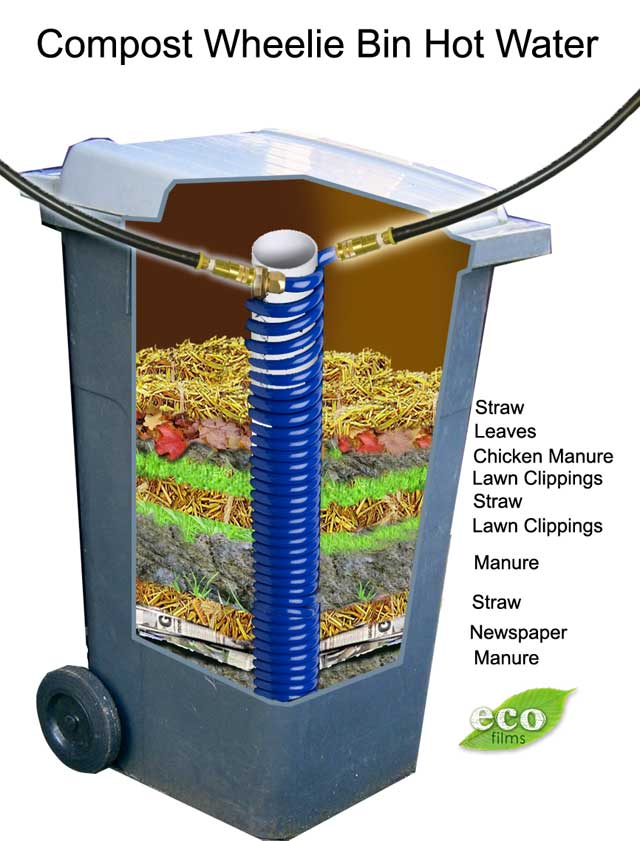
To that end, I quite like the Compost Wheelie Bin Hot Water System (there are any number of other sites showing a similar design - I couldn't quite be bothered to track down who did it first, I just gave up once I'd found a site that quoted measurements).


It works pretty much like the name suggests - you stick green stuff in a wheelie bin, with a water coil down the centre. Several sites I found suggested it would last comfortably for about 4 weeks, though they also said it takes about a week to peak and suggested starting another one two weeks in to tag team them. Two of these, swapped in and out, could do quite comfortably during the build for our little house, and let me have my experiment.

For a more long-term solution I quite like the Pain Mound, and this is where I could see compost-powered water heating working for Kyle and I.


I first found this one through an instructable, and later tracked down the original book on the matter (long out of print but available as pdf). The bits that really caught my attention were that Pain's goal wasn't just convenient cheap energy, but fire risk reduction in the forests near his farm (an ever-present risk in rural Australia). A bit more hunting around and I found someone else had taken on the water heater idea and very recently produced another book on the matter, which I'm about to order a copy of.

It might take me a bit of work to convince Kyle (or even just myself) that compost-powered hot water is a good move though. The particular lifestyle we're looking for does not involve isolating ourselves from the world entirely and digging in off-grid. We'll still have our day jobs, we just aim to be less dependent upon them. Whilst education is a fairly safe industry to work in most of the time, in that the job itself isn't going anywhere, the idea of being able to retire at 35 if the work dries up (or if the mood takes us) is an attractive one. Not that we'd have to, we just could if we wanted to - the idea is to have choices, open up options, rather than lock ourselves into the traditional game of life.

Thursday, September 4, 2014

Hot Water

In considering options for a hot water system for our house I began with quite a few assumptions, some of which have proved false, a few wants, and just a few needs that could not be compromised. There seemed to be the following general options:

System Pro’s Con’s
Electric storage tank
  • Cheap upfront
  • Many models
  • Common (maintenance familiar to tradesmen)
  • energetically expensive to run
  • takes up a lot of space
Gas storage tank
  • Cheap upfront
  • Many models
  • Common (maintenance familiar to tradesmen)
  • less energy than electric storage tank
  • takes up lots of space
  • energetically expensive
Electric on-demand
  • takes up less space than storage tanks
  • more energetically expensive than gas on demand
  • can end up more energetically expensive than electric storage tank, depending on use
Gas on-demand
  • takes up less space than storage tanks
  • ... requires gas? 
Heat pump
  • less energetically expensive than regular electric elements
  • still requires electricity
  • loud during operation 
Solar
  • no additional energy source required
  • requires secondary booster system to maintain stable temperature 

For the same reason as others before us Kyle and I rapidly came to the conclusion that the type of water heater we have in our current house (traditional electric element with storage tank) will not work in the intended ones, either the 'prototype' or the bigger house. I did a little bit of reading of some very boring comparison tables to confirm this assumption before quite happily discarding them altogether as an option.

We are very reluctant to chose any system relying on electricity, as this places greater pressure on solar panels which are expensive. It seems wise to follow a policy of minimising use of electricity altogether as part of our intended way of living. Thus, electrical on-demand systems and heat pumps will probably not be the eventual choice.

On a side note, an ex-geologist friend of mine presented a great argument a year or so ago about why he thought our area would find itself in the next 5 years rapidly short on fuel for gas appliances as nearby sources were exhausted. Whilst I didn't really follow the specifics of his claim at the time, and haven't (yet) looked into it in detail myself since, the discussion lingers in the back of my mind as I generally trust his opinion. Thus I would be reluctant to commit irreversibly to gas alone for water.

Solar collectors with 'boosting' from gas or electricity are becoming more common. After considerable reading I found several anecdotal accounts (1, 2, 3) of individuals who used unboosted solar collectors with satisfactory results, mostly in low use households. As we want to limit our external energy needs this would be ideal, and my (by no means expert) understanding of physics leads me to thinking that with a very large, well insulated storage tank you could achieve relatively stable temperatures.

However, Kyle has a quirky medical condition that means he doesn't feel pain and struggles to identify extremes of temperature (sounds weird, I know). Whilst I don't particularly mind the slight variation in temperature expected from solar collectors, this is a very real safety concern for Kyle who can't tell the difference between 'hot' and 'too hot' but will still burn if he turns it up further. Current strategies for avoiding daily injury depend on Kyle being able to memorise how far to turn the taps on - variable temperatures from the hot water system would make this unreliable.

Initially Kyle and I both assumed that this would rule out stand alone solar systems entirely, however I was reluctant to abandon them. My thinking ran along the lines that the risk isn't the days when the temperature is lower than 50°, it's on the days that the temperature is high enough to scald. In a traditional system this would be controlled by a valve that mixes the hot water with cold water as it exits the tank, and you can turn it up and down with a spanner. We already knew enough about these manually controlled valves to know our current home doesn't have one, hence why Kyle risks scalding daily.

A bit of digging, and I found variable valves which will result in a water mixture of consistent temperature regardless of the inputs. One of those "I can't believe we'd never heard of this before" moments. I have slight concerns that all models I found seek to provide temperature stability in both directions, whereas we're really just concerned with keeping it below a certain point and don't mind if it falls a little further, but this is a start!

So at this stage we're keen to explore un-boosted solar further, but may end up with a gas on demand system. A little more research yet.