Saturday, October 25, 2014

Ducks!

This whole project began for us a few years ago, emerging from Kyle's enthusiasm for vegetable gardening which has been infectious. So we've given a fair amount of consideration over time to what vegetables and fruits we'd like to grown when we eventually have the space for them. At our current place we have a small patch (about 4m by 3m) that does well in summer but is fully shaded all winter, and another section made up of as many pots as I can cram into the paved area around the other side of the house. The first year we were here we had some overly-successful experiments resulting in an abundance of tomatoes and zucchini (which I've vowed never to plant again because I never used them).

We've also given considerable thought to animals also. We already have a cat (strictly indoors). Kyle grew up on a pig farm, so this seems like an obvious choice. Pigs necessitates getting a dog, a gun, or (most likely) both as the presence of domestic pigs is likely to draw interest from feral ones which can be dangerous but are somewhat deterred by large dogs. I'd love to keep bees, which is probably a separate post, and rather than keep ornamental birds we'll just plant lots of things they like so as to attract wild ones. So, cats, dogs, pigs, bees and birds.

But then there was the endless discussion about chickens.

I quite like a breakfast omelette, of a morning, and thought free range chickens a great idea. Kyle, who is violently allergic to eggs, didn't see the appeal. Our current neighbours have a rooster which doesn't seem to realise dawn is still hours away at 2am giving us a rather strong impression of the noise associated with chickens, and there was considerable objection to the inevitable scratching in the veggie patch that would occur. A conundrum.

But then, and I'm embarrassed to say it never occurred to us earlier, we happened upon ducks! Seems like all the insect-collecting benefits of chickens without the down sides, and considerably more character to boot. We'd have to manage water very carefully to ensure a consistent supply, but once the property is established with collection tanks this should be straightforward. We haven't tested the theory yet, but it seems sometimes allergies to chicken eggs don't transfer to duck eggs - Kyle is crossing his fingers as he's always liked the smell of eggs cooking. Plus, the cuteness of fluffy little chicks is eclipsed only by a congo line of fuzzy ducklings following mum for the first swim.

Ducks it will be!

Saturday, October 11, 2014

Radon Off-gassing

Until very recently I'd never even heard that Radon in homes could be a problem, so when a friend of mine mentioned to me a few weeks ago that it might be a concern in an underground house I began looking into it. What I came across was a bunch of websites from the USA telling me about how it leads to lung cancer and I should be very worried about it, and here's who I can pay loads of money to to fix my home. Ka-ching!

I like to look a little deeper into things like that.

So, I started with what its all about anyway - where does it come from? Apparently, underground. The gist of it seems to be that Radon gas exists in the soil, at varying levels across the world, and slowly leeches up into the atmosphere. It's radioactive decay over time can contribute to lung cancer and other unpleasantness, particularly at high levels, though there doesn't appear to be useful data on 'safe' levels, just 'advisable' levels (US website are careful to make this distinction, the cynic in me thinks). The concern is that it enters houses through their foundations where it accumulates indoors due to the lack of air movement. This is apparently quite an issue in basements particularly.

So, on the surface at least, for someone wanting to build an essentially underground house this seems quite a worry. But I like to be thorough, so I started thinking about what factors contribute to the information gleaned above, which seems to be widely accepted as fact (at least by organisations trying to sell solutions, and the US government agencies charged with addressing the problem).

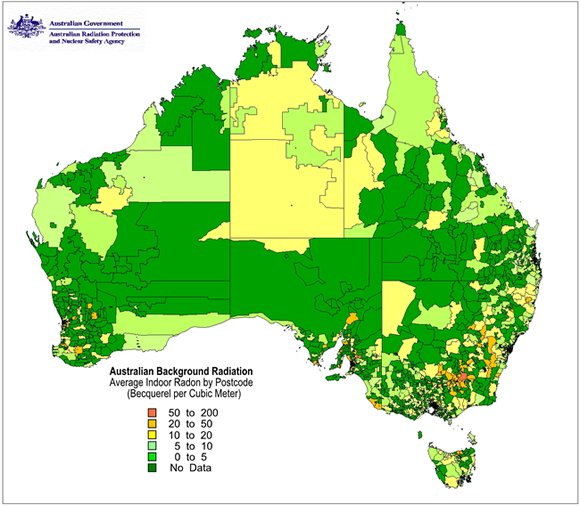
Firstly, it is clear that Radon levels vary from place to place. Much of the initial information I came across was from the US, describing it as unusually high compared to global levels. ARPANSA conducted an Australia-wide survey in the 1990s which seems to indicated Australian levels (¬11 Bq/m-3) are lower than elsewhere (¬40 Bq m-3).

Very comforting.

However, upon closer inspection this refers to the indoor levels only. This is significant because there's a possibility (indeed probability) that the variable causing the difference between areas relates to the type of house rather than any inherent difference in the Earth's crust. In truth, I would assume a bit of both. The plot thickens.

One can assume, for instance, that part of the issue in the US with basements is because they aren't as well ventilated as above-grade spaces, leading to an accumulation of Radon as it off-gasses through the foundation. One might also assume that in deep winter or the extremes of summer people actively seek to limit ventillation in their houses to keep air temperatures consistent and not waste all that energy-hungry air conditioning. It's unclear, though, how much this plays a part in geographical differences regarding Radon accumulation.

I could hypothesise based upon the above map (for example, I notice that the area of high concentration on the NSW/VIC border is an area in which it is both very hot in summer an very cold in winter, perhaps leading to accumulation due to lack of ventilation year round), however I have no way of finding out if this is in fact that case. It also just so happens that that very area of higher concentration is close to where we intend to build, so figuring out if it is an inherent difference in the earth's crust or some function of prevailing building and climate control techniques seems rather important.

As I have no way of knowing this (despite several hours of energetic googling on the subject) I turn instead to methods of limiting Radon accumulation as it seems like perhaps we should consider doing that anyway. Pleasantly, after a bit of searching, I found that the most effective methods are based around aspects of construction we will need to do anyway when building with earthbags. Problem solved!


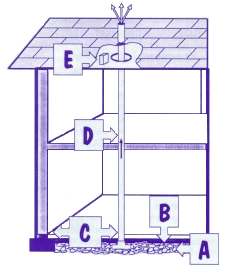
Firstly [A] a permeable space below the floor (eg. gravel, which we have to do anyway for drainage). Secondly [B] a non-permeable layer above A but below the floor (eg. plastic, which is easy to add in during construction). Thirdly [C] sealing all openings in the floor (eg. around pipes, which one would want to do anyway). Next [D] a pipe from below the foundation to above the roof to allow the gas to disperse into the atmosphere rather than indoors (pretty easy to include during construction), and [E] a roughed in electrical box to put a fan in later (seems a little pointless, but I totally get that if you're going to do a thing do it properly).

There don't appear to be any regulations around controlling Radon levels indoors (although I may not be looking for the right thing there). So, given that the risk of Radon accumulation is essentially completely unknown (fancy government survey's not withstanding), but addressing the possible risk is pretty easy if done during construction and almost impossible if attempted later, I figure we might as well add in the pipe.

Wednesday, October 1, 2014

Compost water heating

I've seen a few compost water heaters now, on my search for hot water systems. I was far from convinced that they were for us, however. Most seemed either a lot of work to maintain, or don't last very long. The geek in me still likes the idea, though - somehow it seems a little like hacking nature.

So I started thinking - maybe a compost heap water heater won't work for us for the main house. But before the house is up we'll be on site for a period of a month or two at least, essentially camping. Whilst Kyle and I are no strangers to camping, we're not against doing so with some added comforts. It also occurs to us that we'll be more able to conscript convince our friends and relatives to help if we have ammenities available.

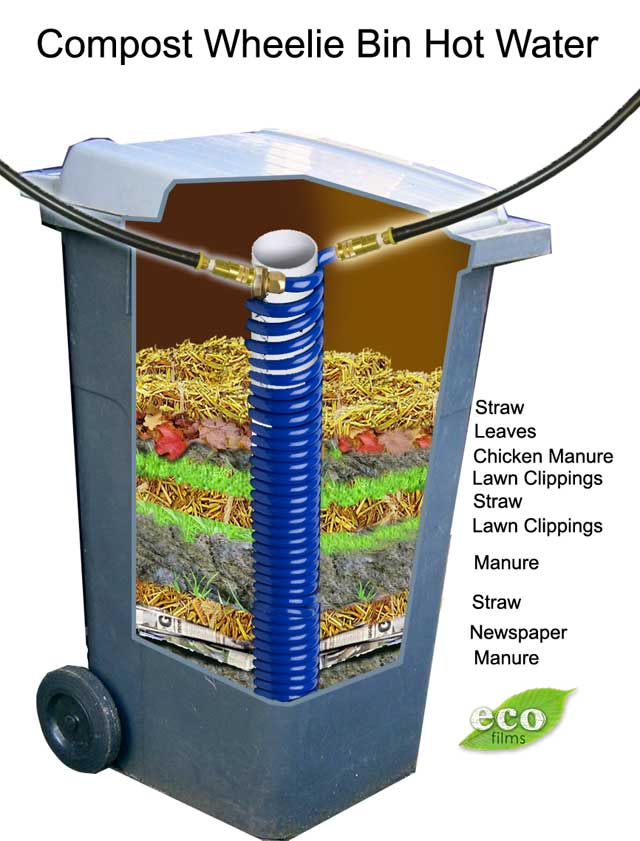
To that end, I quite like the Compost Wheelie Bin Hot Water System (there are any number of other sites showing a similar design - I couldn't quite be bothered to track down who did it first, I just gave up once I'd found a site that quoted measurements).


It works pretty much like the name suggests - you stick green stuff in a wheelie bin, with a water coil down the centre. Several sites I found suggested it would last comfortably for about 4 weeks, though they also said it takes about a week to peak and suggested starting another one two weeks in to tag team them. Two of these, swapped in and out, could do quite comfortably during the build for our little house, and let me have my experiment.

For a more long-term solution I quite like the Pain Mound, and this is where I could see compost-powered water heating working for Kyle and I.


I first found this one through an instructable, and later tracked down the original book on the matter (long out of print but available as pdf). The bits that really caught my attention were that Pain's goal wasn't just convenient cheap energy, but fire risk reduction in the forests near his farm (an ever-present risk in rural Australia). A bit more hunting around and I found someone else had taken on the water heater idea and very recently produced another book on the matter, which I'm about to order a copy of.

It might take me a bit of work to convince Kyle (or even just myself) that compost-powered hot water is a good move though. The particular lifestyle we're looking for does not involve isolating ourselves from the world entirely and digging in off-grid. We'll still have our day jobs, we just aim to be less dependent upon them. Whilst education is a fairly safe industry to work in most of the time, in that the job itself isn't going anywhere, the idea of being able to retire at 35 if the work dries up (or if the mood takes us) is an attractive one. Not that we'd have to, we just could if we wanted to - the idea is to have choices, open up options, rather than lock ourselves into the traditional game of life.

Sunday, September 14, 2014

Double glazing

It seems a little naf to go to the effort of making a passive solar house and not double glaze the windows. However, earth bag building is an inexact art and double glazed windows of custom sizing are prohibitively expensive. A conundrum.

It's always seemed to me that the challenge of double glazing was in the frame - the rest is just two sheets of normal glass, surely? We could debate the merits of low-E coatings and argon filled cavities for days I'm sure, but the basics is two sheets of glass held a little way apart and sealed well. Glass is easy to get hold of in almost whatever size we want (again, we love the tip shop dearly - people throw away the most amazing things), so then it's just a matter of spacing the glass, sealing it in, and ensuring any moisture trapped in the gap is dealt with.

I found several sites describing various methods of DIY double glazing, from the very simple to the more in-depth. Also, a great how-to.

Optimal distances for double glazing for thermal insulation purposes is somewhere in the region of 10-20mm (sound insulation appears to be different again, opinions vary and I haven't yet delved into actual research articles on the matter). The gap needs to be small enough to prevent convection currents from forming in whatever gas exists in the middle. Any number of spacers from bits of wood to strips of plastic seem to be used for achieving this depending on the frame. I particularly liked this suggestion about how to deal with moisture in the gap - sprinkle a little silica gel in between the glass, and let it absorb the moisture over time. None of this high-tech desiccant stuff!

So two layers of glass is do-able. Do we want the windows to open and close, or be fixed? The answer to this is obvious in a more conventional house where one needs the ventilation. Our house, however, will likely have ventilation tubes running underground to cool the air before it gets to the house itself (the ongoing debate about ventilation tubes vs. wind scoop is ongoing and will be posted later).  Whilst opening windows are pretty there is a whole lot of extra stuff to do with them - more technical to construct, need fly screens, all that sort of thing. It is very tempting to have a screen door that can be left open at need, ventilate via underground tubes, and do away with opening and closing windows all together.

I foresee considerable research going into this decision.

Wednesday, September 10, 2014

Interviewing the bank

We have been advised both by our own knowledge of people, and by several individuals who seem experienced in such things, to approach meetings with banks about home loans as though we are interviewing the banks to see which we'd like to borrow from, rather than the other way around. I tend to approach conversations with planning councils in much the same way - this luxury will obviously end when we actually buy a property, but until then we can just decide to live somewhere else.

Although we've been talking about buying a rural property for several years, it's only recently crystallised into an actual plan. We're quite lucky, then, that this process has coincided with what appears to be a fall in the prices of such properties. People don't necessarily want to take on what they perceive is a large amount of risk at times when things are changing around them - buying a hobby farm and building a house yourself definitely seems an endeavour of considerable risk by conventional thinking.

Last week, after considerable reading around, we met with our current bank to interrogate their representative about their processes and products and potentially decide if they're a suitable lender for our unconventional purpose. We were aware from the experience of several friends that many financial institutions will require a larger deposit on rural properties of considerable size, though opinions vary on what the size and zoning rules might be. It's worth being aware that rules are considerably different for land with no existing dwelling than they are for large properties that have an existing house.

So now we begin the onerous journey of comparing various loans and subjecting ourselves to the whims of mortgage brokers to find a deal that works for us. The irony of having to buy in to the whole mortgage debacle in an effort to escape ever having to do it again is not entirely lost on us.

Tuesday, September 9, 2014

Owner Builder Permits

The NSW Office of Fair Trading requires that individuals be licences as 'Owner Builders' in situations where the building work relates to a dwelling that requires complying development approval. Thus, either Kyle or myself must get an owner builder licence.

Originally we thought Kyle would be the ideal candidate, having previously worked in construction. However a severe knee injury, reconstructive surgery, and several months of physio later Kyle's white card has been invalidated and requires a lot of hoop-jumping to reinstate. Jenny, however, is a clean slate in the construction industry.
  1. The White Card
  2. Owner Builder Certification
    • Cheapest/Easiest through Absolute Education ($189 September special)
    • Also do white cards in a deal with owner builder certs, but more expensive.
  3. Owner Builder Insurance
    • Australian Owner Builders Insurance Services looks likely (specifically covers mud brick structures, good start) but I haven't looked into it with a lot of detail yet.
    • Would only need it once we start the project (it's useless before we buy a property anyway)
    • In an ideal world we're all understanding people who don't sue each other over accidents, but insurance is what you have just incase it's not an ideal world after all.
An important point for us to be aware of at this stage is that it is likely there will be a requirement that anyone who helps us build the house (including Kyle) will need a white card as well. I've been trying to work out what's happened on other similar projects (such as Earthships) regarding this, but it's difficult to get details that specific for Australian builds that are very recent. Just another of the variety of hoops to jump through on atypical projects.

Friday, September 5, 2014

Eco-Builds as Sovereign Risk Insurance

I was recently sent an article comparing the economic policies of various Australian governments past and present, which set off an interesting string of email discussion with various members of my family. During this discussion my father decided he was appalled at the thought his daughter felt the need to take out sovereign risk insurance.

Sovereign Risk is described by economists as what happens when governments default on their debts. A concept that's come up a lot over the last few years, though not often by that name. Sovereign Risk is considered particularly relevant by industries such as mining which have a very long-term return on investments. When starting an open-cut mine, for instance, one expects it will be in operation for several decades. 'Soverign risk' is the possibility that the government of the day sometime further down the track along those several decades will make decisions which change the profitability of the mine from what was first expected. For example, Australia suddenly introducing a mining tax certainly raised Rio Tinto's assessment of its sovereign risk in this country, and the next government removing the tax just makes the economic climate more uncertain rather than less risky (Not that I particularly disagree with the mining tax - it just provides a good example).

Kyle and I have many reasons for pursuing the project around which this blog is based. One of them, is that we are concerned about the direction public opinion and political will is taking society around us. Whilst we are quite well off, and would ourselves probably end up in the category of the 'haves' rather than the 'have nots', current policies lead to the type of society we don't particularly want to live in anyway. On the off-chance that the general public hasn't quite woken up to this yet and votes the Liberals back into power we're looking at a collective future in which individuals cannot depend upon social support services. We don't want to risk being tied to expensive mortgages and rising energy costs, necessitating the stressful career choices that would go with supporting that.

Coupled with the inability for government to admit climate change is likely to be a problem, leading to food/water/energy/safe housing shortages in 30-40 years, we figure we may actually need to support ourselves on that front for at least some length of time. Sounds rather extreme, and a little bit on the side of sci-fi apocalypses, but more and more becoming a real possibility for the distant future.

If you stop bothering to attempt to convince conservatives that climate change will happen and we need to plan for it, or that social policies will benefit us all in the long run, then you start thinking about how to survive it if they don't. We figure on the off-chance that it pans out that way we should probably think about living outside the systems we won't necessarily be able to depend upon. The alternative is moving to another country (Jenny, by virtue of ex-pat well-travelled parents, has triple citizenship, so we would be able to do this fairly easily), but it begs the question of where to?

 So, in a sense, we are looking at the long term plan for ourselves within this society and developing our own insurance for that eventuality. Thus, amongst so many other things, this project represents some insurance in the form of self-sufficiency against the risk that not enough is done to slow the changing of the climate, and that help is unavailable if this or other ills befall us.